
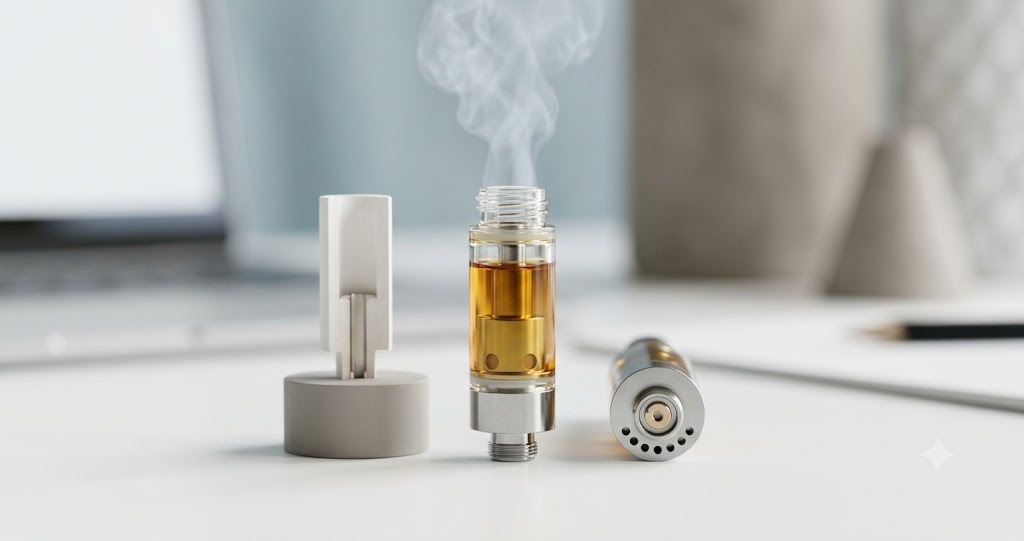

Experiencing burnt hits or restricted draws midway through a vape cartridge frustrates every consumer. Flavor degradation often stems from inferior internal components rather than oil quality, wasting both material and money. Analyzing structural design parameters solves this issue directly. This technical analysis breaks down the internal architecture, thermal performance, and draw resistance of authentic cartridges to ensure you get consistent vapor every time.
Evaluating hardware requires looking past external branding into pure mechanical engineering. The interaction between heating elements, oil viscosity, and intake geometry determines overall vapor performance. The ultimate
How Ceramic Cores Manage Heat Distribution
Internal thermal management dictates how well a cart preserves delicate terpene profiles during activation. Conventional cotton or metal coils create localized hot spots exceeding 550°F, instantly scorching volatile aromatic compounds. Modern porous ceramic matrices distribute heat evenly across an expanded surface area. This engineered diffusion holds operating temperatures between 380°F and 420°F under standard standard 3.2V loads.
       [ Intake Apertures (Dual 1.8mm) ]
                     │
                     ▼
       [ Porous Ceramic Core Matrix ]  <-- Uniform 380°F–420°F Heating
                     │
                     ▼
       [ Central Stainless Steel Chimney ]
                     │
                     ▼
       [ Low-Resistance Airflow Channel ]
Porous ceramic acts as an active reservoir, pulling viscous distillate into micro-capillaries via passive absorption. This capillary action ensures continuous saturation around the internal heating filament during rapid activation cycles. By eliminating dry pockets near the heating wire, the ceramic structure protects oil purity while preventing dry hits.
The molecular density of the ceramic ceramic element governs absorption speed. High-porosity matrices handle thick, uncut extracts without requiring chemical thinning agents like propylene glycol or added terpenes. You achieve dense vapor production without sacrificing flavor integrity or thermal efficiency.
Airflow Quality and Intake Port Architecture
Airflow dynamics depend heavily on intake port sizing and central chimney geometry. Dual 1.8mm intake apertures positioned at the base of the chamber regulate fluid entry into the ceramic core. These calculated dimensions balance fluid dynamics against surface tension, allowing thick oils to enter without flooding the center tube.
The internal chimney utilizes surgical-grade stainless steel with a polished inner wall to minimize condensation accumulation. Air enters through base inlet slots, passes around the heating element, and travels up the central column. This direct path maintains laminar airflow, reducing internal turbulence that causes spitting or gurgling.
Customizing your voltage output complements this intake architecture. Running a battery between 2.8V and 3.4V maintains steady vapor velocity. Lower voltages yield rich flavor profiles, while slightly higher settings increase vapor density without overwhelming the core’s thermal absorption rate.
Hardware Construction and Leak Prevention Design
Structural integrity determines whether a cartridge survives daily transport and temperature fluctuations. Medical-grade borosilicate glass forms the outer reservoir, offering superior chemical resistance compared to polycarbonate plastics. Plastic housing can leach compounds or crack when exposed to concentrated terpene profiles; borosilicate remains completely inert.
Dual silicone gaskets seal the top mouthpiece connection and the bottom threading interface. These high-temp O-rings form a vacuum-tight seal that prevents ambient air pressure changes from forcing oil through the intake ports. This pressure balancing system keeps liquid locked inside the reservoir during altitude shifts or vehicle transport.
To explore options across different product lines and verified hardware revisions, review the official
Structural Material Specifications
-
Reservoir Tank: High-clarity borosilicate glass (1.8mm wall thickness)
-
Center Post: Lead-free brass with food-grade chrome plating
-
Internal Seals: High-grade synthetic silicone O-rings
-
Mouthpiece Material: Heat-resistant ceramic or anodized aluminum
-
Thread Standard: Universal 510-thread connection
Hardware Diagnostics Matrix
The following decision framework diagnoses common performance issues based on hardware symptoms and thermal behavior.
                  [ Vapor Quality Issue Detected ]
                                 │
           ┌─────────────────────┴─────────────────────┐
           ▼                                           ▼
  [ Scorch / Burnt Taste ]                   [ Restricted Airflow ]
           │                                           │
  ┌────────┴────────┐                         ┌────────┴────────┐
  ▼                 ▼                         ▼                 ▼
[Voltage > 3.6V]  [Fast Puffs]             [Oil Condensation] [Clogged Base]
  │                 │                         │                 │
  ▼                 ▼                         ▼                 ▼
Lower Voltage    Allow 15s Wicking           Warm Device       Clear Center Pin
(2.8V - 3.2V)    Between Hits                Vertically        Air Slots
When diagnosing vapor issues, check your battery connection first. Dirt or leaked oil on the 510 threads disrupts voltage delivery, leading to incomplete vaporization and severe airflow restriction.
Evaluating Flavor Fidelity and Terpene Retention
Terpene preservation relies entirely on precise temperature control during vaporization. Low-boiling-point monoterpenes evaporate quickly above 315°F, making low-temp operation essential for full flavor profiles. The ceramic core’s even surface heat prevents flash vaporization, keeping delicate flavor notes intact from the first draw to the last.
Vapor cooling happens inside the central stainless steel tube before reaching the mouthpiece. The thermal mass of the chimney absorbs excess heat, delivering smooth vapor at room temperature. This cooling path prevents throat irritation commonly caused by hot, unrefined vapor streams.
Exploring diverse terpene profiles requires hardware capable of rendering subtle flavor notes without distortion. Browse the available selection of
Hardware Maintenance and Performance Optimization
Proper handling preserves core wicking capabilities and prevents premature hardware failure. Store cartridges vertically at room temperature to keep oil concentrated over the bottom intake ports. Leaving cartridges on their side allows oil to flow away from the core, increasing dry-hit risks upon activation.
Avoid exposure to direct sunlight or extreme temperatures, such as inside a parked vehicle. Excessive heat thins the oil rapidly, breaking the internal vacuum seal and causing leaks through the airflow slots. Conversely, freezing cold thickens the extract, requiring a gentle pre-heat cycle before draw activation.
For general updates on vapor testing methodologies and component specs, check out the
Frequently Asked Questions
What voltage setting works best for ceramic core cartridges?
Keep your battery between 2.8V and 3.2V for optimal performance. This range vaporizes thick extracts cleanly, preserves delicate flavor compounds, and prevents premature coil burnout.
How do dual 1.8mm intake ports prevent cartridge flooding?
The 1.8mm diameter balances extract surface tension against natural core capillary draw. It feeds high-viscosity oil continuously into the ceramic matrix without letting excess material flood the inner chimney.
Why does ceramic outperform metal coils in vapor quality?
Ceramic elements distribute thermal energy evenly across a porous matrix, preventing high-temperature hot spots. Metal coils heat unevenly, which scorches organic compounds and produces harsh, burnt hits.
Optimizing Your Hardware Performance
Maximizing cartridge performance requires matching battery voltage to oil viscosity while maintaining clean hardware connections. Check the base 510 threads regularly and clear any debris from the air inlet holes using a cotton swab dipped in isopropyl alcohol. Operating your battery between 2.8V and 3.2V protects the internal ceramic core, maintains capillary wicking, and preserves full flavor integrity throughout the life of the cartridge. Inspecting hardware integrity before use guarantees a smooth, reliable experience on every draw.