

Modern industries are moving toward faster, smarter, and more digital workflows. Designers, engineers, manufacturers, and creators all need tools that improve efficiency while maintaining high levels of accuracy. One technology leading this transformation in 2026 is the 3d scanner.
Advanced scanning solutions are changing how products are designed, tested, and manufactured. Instead of relying on slow manual measurements or building every model from scratch, professionals can now scan real-world objects and instantly convert them into highly detailed digital models.
This shift is helping businesses reduce development time, improve product quality, and simplify workflows across many industries. From rapid prototyping to reverse engineering, next-generation scanning technology is becoming an essential part of modern production.
Understanding Modern 3D Scanning Technology
A 3D scanner is a device designed to capture the geometry and surface details of physical objects. Using technologies such as structured light or laser scanning, the device records thousands or even millions of data points from the object’s surface.
This information is processed into a digital 3D model that can be edited, analyzed, or prepared for manufacturing and 3D printing. Unlike traditional measuring tools, scanning technology captures complete geometry, including curves, textures, and detailed surfaces.
This allows users to work with highly accurate digital replicas instead of manually recreating objects in CAD software.
Why Faster Digital Workflows Matter
Modern product development moves quickly. Companies often need to test ideas, refine prototypes, and launch products in shorter timeframes than ever before. Traditional modeling methods can slow this process because creating accurate digital models manually takes significant time and effort.
A powerful 3d scanner speeds up this workflow by capturing real-world objects directly. Designers and engineers can scan an object in minutes and begin refining the model immediately.
This creates a much faster development process:
Scan → Edit → Prototype → Improve → Produce
By reducing manual work, teams can focus more on innovation and problem-solving instead of repetitive modeling tasks.
Improving Prototyping and Product Development
Rapid prototyping is one of the biggest advantages of modern scanning technology. Designers often create several prototype versions before finalizing a product.
With advanced scanning solutions, physical prototypes can be digitized quickly and modified easily. Instead of rebuilding models from scratch every time changes are needed, creators can scan an existing design and improve it digitally.
This approach offers several important benefits:
- Faster design revisions
- More accurate prototypes
- Better communication between teams
- Reduced development costs
- Shorter production timelines
These advantages help businesses stay competitive in fast-moving industries.
Supporting Precision in Manufacturing
Accuracy is critical in manufacturing. Even small measurement mistakes can affect how parts fit together or perform during operation.
A modern 3d scanner for 3d printer captures highly detailed geometry, helping manufacturers create precise digital models for production and inspection. Scanned data can also be compared directly with original CAD files to identify defects or inconsistencies.
This technology supports:
- Quality control and inspection
- Production planning
- Part verification
- Manufacturing consistency
- Reduced material waste
By improving precision throughout the workflow, businesses can achieve higher product quality while reducing costly errors.
Reverse Engineering Made Simpler
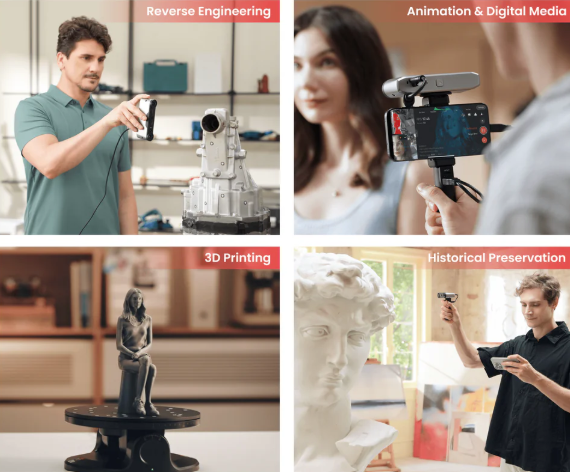
Reverse engineering is another area where next-generation scanning technology provides major advantages. Many industries still rely on older machine parts and products that no longer have original digital design files available.
A 3d scanner for 3d printer allows engineers to capture these physical parts and create accurate digital models for repair, reproduction, or redesign.
This process is commonly used for:
- Replacing damaged machine parts
- Recreating discontinued products
- Updating older equipment
- Customizing existing components
Instead of relying on manual measurements, engineers can work from precise digital data that reflects the real object accurately.
Revopoint and Advanced Scanning Innovation
As demand for scanning technology grows, companies like Revopoint are helping make professional-grade solutions more accessible. At Revopoint, users can explore portable and high-precision scanning devices designed for engineering, manufacturing, product development, and 3D printing workflows.
Revopoint scanners are known for balancing portability, ease of use, and strong scanning performance. Their devices support both industrial and creative applications while remaining practical for everyday use.
Some key features include:
- High-resolution scanning for capturing fine details
- Real-time tracking for smoother scanning workflows
- Portable handheld designs for flexible use
- Compatibility with CAD and 3D printing software
These capabilities make Revopoint scanners valuable tools for professionals, educators, and creators looking to modernize their workflows.
Expanding Creative Possibilities
Modern scanning technology is not limited to industrial use. Artists, hobbyists, and designers are also using scanners to explore new creative possibilities.
Artists can digitize sculptures and handmade objects for editing or replication. Designers can scan prototypes and test new ideas more efficiently. Hobbyists can customize everyday items and create unique digital projects.
This blend of physical creativity and digital flexibility is helping creators experiment more freely and produce more detailed designs.
Final Thoughts
Next-generation scanning technology is changing how products are designed, tested, and manufactured. A reliable 3d scanner allows creators and businesses to capture real-world objects quickly and turn them into highly accurate digital models for development and production.
By improving speed, precision, and flexibility, a powerful 3d scanner for 3d printer helps professionals simplify workflows and achieve better results. With advanced solutions from companies like Revopoint, modern scanning technology is powering faster innovation and smarter manufacturing for the future.